AI inference research lab

Run more AI
on every GPU.

Minima compresses model weights and KV cache, then serves them with a hardware-aware runtime. Increase capacity, fit longer contexts and lower cost per token—without replacing your model or rewriting your application.

Deploy on-premises, in your VPC, or join launch access for the Minima Hosted API.

matched inference demo
QWEN3-32B / A100 80 GB
Vanilla baseline Qwen3-32B via vLLM
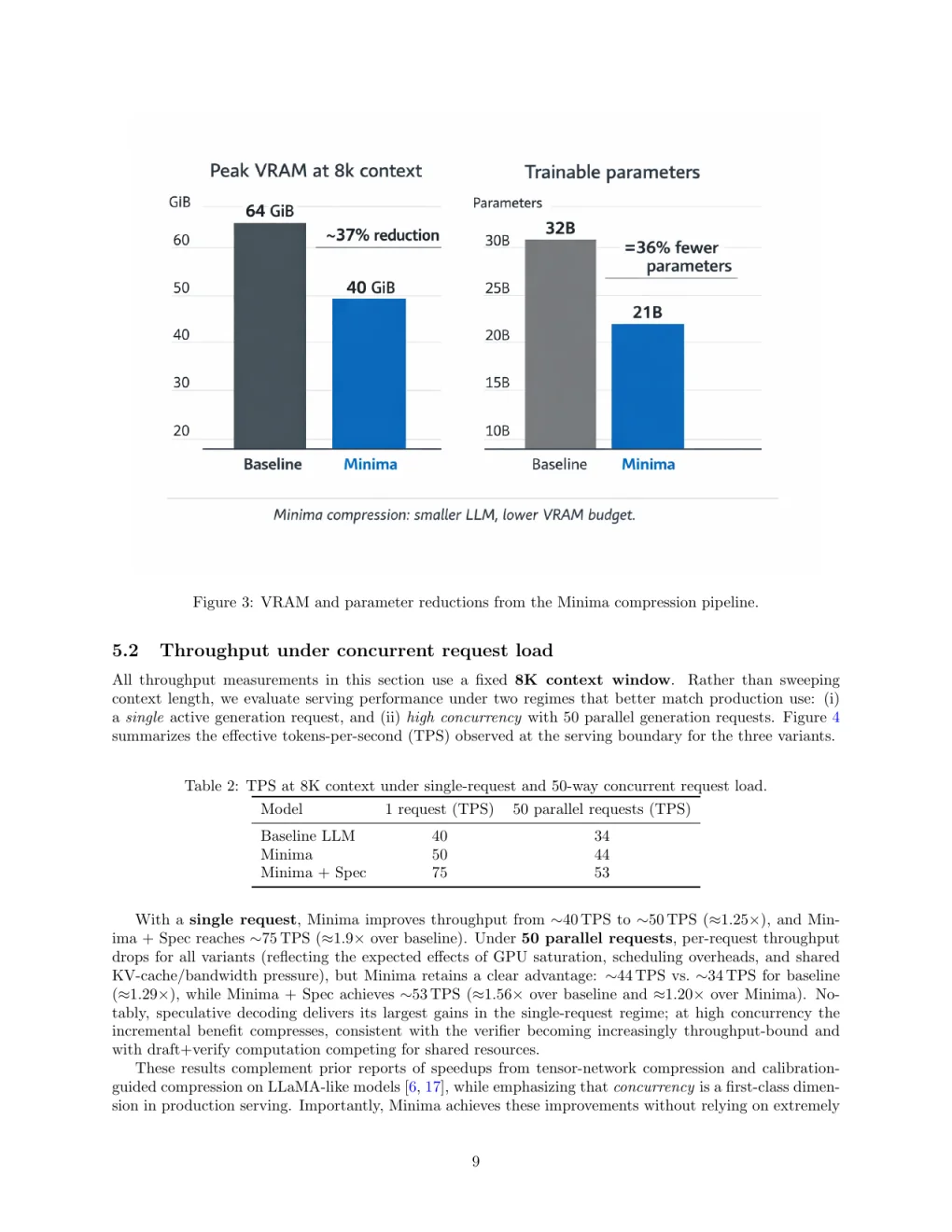
Throughput 45 tok/s
GPU memory 64 / 80 GiB
Qwen3-32B · BF16 · 8K context · 1× A100 80 GB Same checkpoint, prompt, output length and runtime configuration
Minima optimized Qwen3-32B via mnma
Throughput 75 tok/s
GPU memory 40 / 80 GiB
Matched demo run: 45 → 75 tok/s and 64 → 40 GiB VRAM. Published preprint results are reported separately below.

Published system result

Published system results

Qwen3-32B · one NVIDIA A100 80 GB · bf16 · 8K context

Loading paper-backed metrics…

Figures reported in the Minima arXiv preprint submitted February 2026. Results vary by model, hardware, context and traffic shape. See the disclosed setup.

Latest from Minima

Research moving into production systems.

We work across the representation, memory path and serving runtime—because real inference efficiency is a systems problem.

01 / RESEARCH

A practical tensor-network pipeline at 32B scale

Our preprint covers learned sensitivity, mixed Tucker/TT/TR decompositions, healing, custom kernels and speculative decoding in a single production-shaped pipeline.

Explore the paper
02 / HOSTED API
Launch access

Minima-optimized inference through an OpenAI-compatible API

We are preparing hosted access for optimized open-weight models. OpenRouter provider integration is in progress.

Join launch access
03 / OPEN SOURCE

Private retrieval and agent workflows

Minima AI Agent connects enterprise data to source-linked search, chat and configurable workflows in customer-controlled environments.

Explore Minima AI Agent

The mnma engine

Optimize the entire inference path.

Minima is the company. mnma is our model-optimization and inference engine: a coordinated stack for weights, cache and runtime.

01

Model weights

Hardware-aware low-precision formats and tensor-network decompositions reduce weight memory while protecting sensitive regions.

02

KV cache

Tiered compression preserves recent and high-value context while storing older cache pages in compact representations.

03

Runtime

Custom CUDA kernels, scheduling and speculative decoding turn smaller representations into measurable serving gains.

The mnma inference path

Benchmark evidence

Evidence, not benchmark theatre.

Every result is tied to a model, hardware configuration, workload and quality gate. Change the setup and the result can change.

Loading the published benchmark record…

Products

Choose the deployment model that fits your data and economics.

Use the engine in your infrastructure, access optimized hosted models, or deploy a private application stack over enterprise data.

APILaunch access

Minima Hosted API

Use Minima-optimized models through an OpenAI-compatible endpoint.

  • OpenAI-compatible request format
  • Enterprise launch access
  • Usage metering
  • OpenRouter route planned
Join launch access
APPLICATIONOpen-source core

Minima AI Agent

Search, chat and build workflows over private enterprise data.

  • On-premises or VPC
  • Private model and data path
  • Source-linked retrieval
  • Enterprise deployment support
Explore the Agent

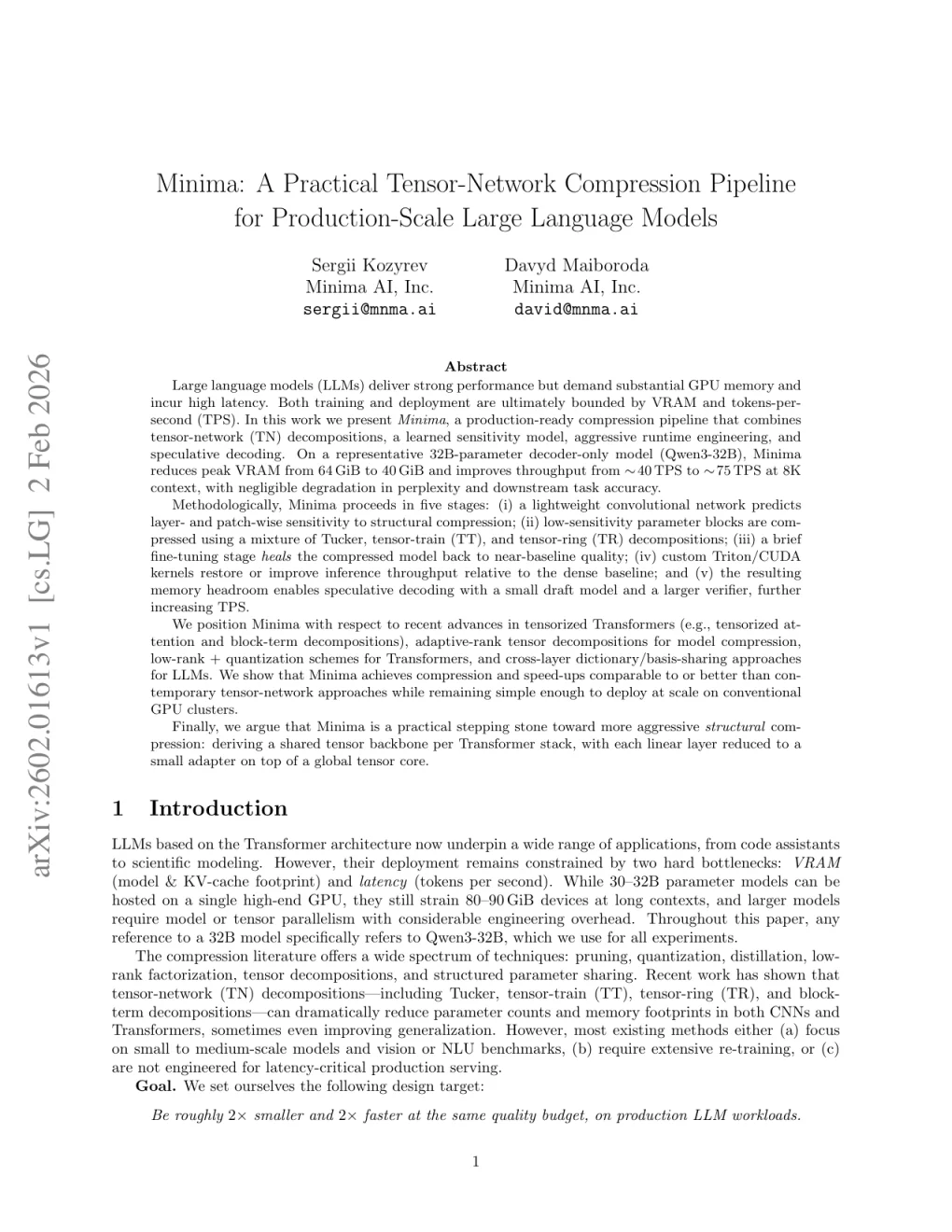
Minima research · arXiv:2602.01613

A practical tensor-network compression pipeline for production-scale LLMs.

Sergii Kozyrev · Davyd Maiboroda · Minima AI, Inc.

The preprint describes a five-stage system: learned sensitivity analysis, mixed structural decomposition, healing, custom CUDA kernel execution and speculative decoding. The central result is not a standalone compression ratio—it is an end-to-end serving result on a disclosed 32B workload.

Scope13 pages · 5 figures
SubjectsMachine Learning · AI
StatusarXiv preprint · Feb 2026
Results page from the Minima paper showing peak VRAM and throughput tables
First page of the Minima tensor-network compression paper
Preview paper

Who Minima is for

Teams treating inference as infrastructure.

We focus on workloads where memory, context capacity, throughput and data control have direct operating consequences.

01

ML platform teams

Fit and serve open-weight or internal models against explicit latency, memory and quality gates.

02

AI product teams

Increase serving headroom before product growth turns GPU capacity into a bottleneck.

03

Regulated enterprises

Keep model traffic within controlled environments and support existing compliance programs.

04

GPU-constrained operators

Explore practical routes to longer context, higher concurrency or fewer deployment nodes.

Company

A focused lab for production inference.

Minima AI, Inc. builds the mnma engine, hosted inference access and private AI applications from one shared systems foundation.

Sergii Kozyrev, co-founder and CEO of Minima AI

Co-founder & CEO

Sergii Kozyrev

Former Principal AI Engineer at Atlassian. Sergii has built production search, recommendation and generative-AI systems and leads Minima's product and inference strategy.

Davyd Maiboroda, co-founder and CTO of Minima AI

Co-founder & CTO

Davyd Maiboroda

An AI systems architect based in California, Davyd leads Minima's model compression, kernel and runtime engineering.

Benchmark with us

See what Minima can do for your model and GPUs.

Send us the model, hardware and workload you care about. We will propose a benchmark with explicit quality, throughput, memory and cost gates.

  • Model or model family
  • GPU and deployment environment
  • Context, concurrency and traffic shape
  • Your quality and latency constraints
Request a benchmark

Submit the form and Minima will contact you about your request. See our Privacy Policy and Terms of Service.